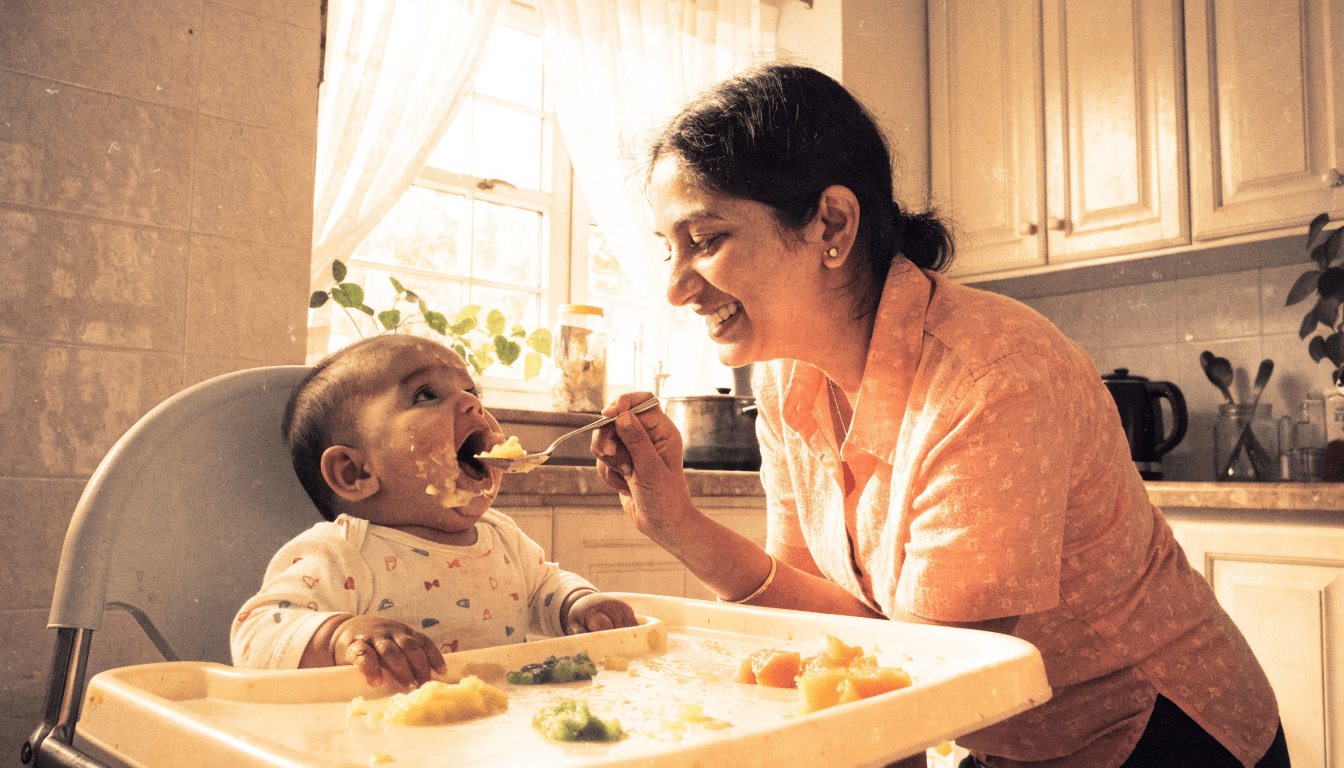
The 6-Month Milestone: Ready for Solids?
At 6 months, your baby's body is ready for solids in a way it wasn't before. Their digestive system has matured, their immune system can handle more variety, and their brain is ready to learn new skills like chewing and self-feeding.
But readiness isn't just about age. Readiness is about developmental signals.
---
Signs Your Baby Is Ready for Solids
Don't start solids based on age alone. Look for these signs:
Physical Readiness Signs
1. Sitting upright with minimal support
They can sit in a high chair without falling over
Their head control is strong
They're not flopping around2. Loss of tongue-thrust reflex
The reflex that pushes food out of their mouth at birth is fading
When you offer food, they're not automatically pushing it out with their tongue
This reflex is protective but prevents eating3. Can grasp objects
They can reach for things and hold them
They might bring toys to their mouth
Fine motor development is progressing4. Shows interest in food
They watch you eat
They reach for your plate or cup
They drool when you're eating
They open their mouth when they see foodReadiness Checklist
```
☐ Baby is 6 months old (or very close)
☐ Baby sits upright in high chair with minimal support
☐ Baby doesn't automatically push food out with tongue
☐ Baby can pick things up (developing grasp)
☐ Baby shows interest in food (reaches, watches, opens mouth)
```
If most of these are YES, you're ready. If not, waiting another few weeks is fine—no rush.
---
Before You Start: Safety Checks
Allergies & Family History
Before introducing potential allergens, know your family history:
Common allergens:
Peanuts and tree nuts
Shellfish and fish
Eggs
Milk/dairy products
Sesame
SoyCurrent allergy research: Early exposure to allergens actually reduces allergy risk. So introducing peanuts, eggs, and fish at 6 months is protective. BUT if you have significant family allergies, talk to your pediatrician first.
What to do:
Introduce allergens one at a time (with a few days between each)
Watch for reactions: hives, swelling, vomiting, diarrhea, extreme fussiness
Introduce at home, not at a restaurant (so you can monitor)
Introduce during the day (not right before bed)Signs of Readiness to Avoid Choking
At 6 months, babies:
Still don't have back molars (won't develop until 12–18 months)
Can't chew effectively
May have limited gag reflex controlThis is why:
First foods are soft or pureed
Small pieces (pea-sized)
Never hard, round, or sticky foods
You're supervising closely---
Best First Foods for 6-Month-Olds
Single-Ingredient Foods (Start Here)
These are safest for watching for allergies:
Iron-rich foods (important at 6 months):
Ragi (finger millet): Cook into a thin porridge with water or breast milk. Iron-rich, gentle on digestion. Perfect first food.
Rice: Simple, bland, unlikely to cause allergies. Mix with breast milk to make creamy.
Dal (lentils): Cooked soft and pureed. Red lentils are easiest to digest.Fruits & vegetables:
Banana: Mash with fork. No cooking needed. Soft, sweet, easy to digest.
Sweet potato: Roast or steam, then mash. Mild, sweet, nutritious.
Apple: Steam or cook until soft, then mash. Not raw (choking risk at 6 months).
Avocado: Mash raw. Creamy, fat-rich (good for brain development).
Pumpkin: Steam, mash.
Carrot: Steam until very soft, mash well (raw is choking risk).Proteins:
Eggs: If no family egg allergy, offer early (protective for allergy development). Start with yolk only at 6 months; whole egg at 7 months.
Paneer: Soft Indian cheese. Crumble into very fine pieces.India-Specific First Foods
Indian parenting traditions have developed solids for centuries. These are excellent first foods:
Khichdi (the perfect first food):
Rice + dal + ghee, cooked soft
Easily digestible
Balanced nutrition (carbs + protein + fat)
Many Indian babies' first food
Recipe: 1 part rice + 1 part dal + 4 parts water, cooked until soft, mashedRagi (most nutritious):
Traditional finger millet porridge
Iron-rich (important at 6 months when breast milk iron depletes)
Easy to digest
Slightly sweet taste
Recipe: 1 part ragi powder + 3 parts water, stirred to avoid lumps, cooked 5–10 minutesRice porridge:
White rice cooked soft, mashed with breast milk
Very gentle
Often tolerated by sensitive tummiesMoong dal (mung bean):
Light, easy to digest
Cooked soft and pureed
Good protein sourceFoods to Avoid or Delay
Never:
Honey (botulism risk until 12 months)
Whole nuts (choking risk; nut butters okay at 8+ months if thin)
Raw or hard vegetables
Small round foods (grapes, cherry tomatoes—whole)
Sticky foods (nut butters thick, marshmallows)Delay:
Salt (avoid until 12 months; breast milk has enough)
Sugar (unnecessary; fruits are sweet enough)
Spices (introduce gradually after 8 months; very mild initially)
Cow's milk as main drink (formula or breast milk still primary)
Wheat & gluten (fine at 6 months, but wait if family celiac history)---
Two Approaches: Purees vs. BLW
Both work. Choose what fits your family.
Purees (Traditional Approach)
What it is:
Mash or blend food into a smooth or semi-smooth texture
Spoon-feed to baby
Gradually reduce smoothness as baby developsAdvantages:
Easy to control portions
Can monitor exactly what baby eats
Less mess (though still messy)
Easier to spot allergic reactions
Develops on its own timeline in many culturesDisadvantages:
Takes more prep work
Spoon-feeding can become dependent
Less tactile exploration
Some babies refuse transition to lumpy foodsHow to do purees:
Cook single ingredient until soft
Mash with fork or blend with water/breast milk
Consistency: thin at first (watery porridge), gradually thicker
Spoon-feed, watching for signs of fullnessBaby-Led Weaning (BLW)
What it is:
Offer soft finger foods (not pureed)
Baby self-feeds, picks up pieces
No spoon-feeding; baby controls pace and amountAdvantages:
Mimics natural progression (self-feeding earlier)
Baby controls portions and pace
Less prep (just cook and offer)
Natural exploration of textures
Some research suggests reduced picky eating laterDisadvantages:
Messier (food everywhere)
Harder to monitor exact intake
Requires vigilance about choking hazards
Some babies initially struggle (gag reflex strong)How to do BLW:
Cook food until soft enough to mash with fork
Offer strips, sticks, or soft pieces
Baby picks up, explores, brings to mouth
You supervise, don't assist much
Let baby set pace—some eat lots, some taste and rejectCombination Approach
Most families blend both:
Purees for very new foods (easier to monitor)
BLW for familiar, soft foods
Spoon-feeding sometimes, self-feeding other timesThere's no "right" way. Choose what feels manageable for you.
---
Introducing New Foods: The 3–5 Day Rule
When introducing a new food, wait 3–5 days before introducing another new food.
Why?
Allergic reactions might take 2–3 days to appear
You can identify which food caused a reaction
Easier digestion as baby adjusts to new foodWhat to watch for:
Rash or hives
Swelling (lips, face)
Vomiting
Diarrhea
Extreme fussiness or eczema flare
Any breathing changes (seek emergency care)Mild reactions you might expect:
Slightly loose stool (normal as digestion adjusts)
Extra drooling
Diaper rash from new food
Minor fussiness (digestive adjustment)These are usually fine; continue unless worsening.
---
How Much Should a 6-Month-Old Eat?
Spoiler: not much.
At 6 months, solids are exploration, not primary nutrition. Breast milk or formula is still the main source.
Typical 6-month eating:
1–2 teaspoons per meal (yes, teaspoons)
Might work up to 2–3 tablespoons by 8 months
Maybe 1–2 times per day initially, increasing to 2–3 times by 8 monthsThe point:
Baby is learning to eat (practice)
Baby is exploring flavors (interest development)
Baby is developing skills (coordinating mouth, swallowing)
Nutrition is bonus, not goal yetSigns of fullness:
Turns head away from food
Pushes spoon away (if spoon-feeding)
Loses interest
Closes mouthRespect these signs. Never force food.
---
Allergies & Food Sensitivities
Common Reactions & What They Mean
Mild reactions (likely fine to continue):
Slightly loose stool or extra gas (digestion adjusting)
Very light rash that goes away
Extra fussinessReactions to watch carefully (might need to stop):
Eczema flare or worsening
Persistent rash
Mild vomiting
Blood in stoolReactions requiring immediate stop + pediatrician call:
Swelling of lips or face
Difficulty breathing
Severe vomiting
Extreme fussiness (extreme, not just fussy)
Multiple systems affectedIf You Suspect an Allergy
Stop the food
Call your pediatrician
Describe symptoms and timeline
Wait at least 1 week before reintroducing
Reintroduce only on pediatrician's adviceMost food reactions are mild and pass. But trust your gut—if something feels wrong, check with your doctor.
---
Hydration & Breast/Formula Feeding
At 6 months starting solids:
Breast milk or formula is still PRIMARY nutrition
Solids are supplementary (exploration)
No cow's milk as main drink yet (wait until 12 months)
Water isn't needed yet (breast milk/formula provides hydration)
By 8–9 months, offer water in an open cup or sippy cup (not required, but good practice)Feeding schedule might look like:
Morning: Breast/formula
Mid-morning: Solids (1–2 teaspoons)
Afternoon: Breast/formula
Early evening: Solids (1–2 teaspoons)
Evening: Breast/formula + bedtime routineThis is one example. Your schedule will vary based on your baby's needs.
---
India-Specific Considerations
Spice & Indian Foods
Traditional Indian foods have spices. When can you introduce them?
At 6 months:
Keep bland and mild
No chili, excess turmeric
Plain dal, rice, khichdi
Mild flavors onlyBy 8–9 months:
Introduce mild spices very gradually
A tiny pinch of turmeric (anti-inflammatory)
Very mild amounts of cumin or coriander
Still mostly mildBy 12 months:
Can handle more spice
But still gentler than adult food
No super-hot foods yetWhy?
Digestive system still maturing
Spices can irritate or cause reactions
Developing taste preferences matters (mild tastes become familiar)Traditional Indian First Foods
Many Indian families start with:
Ragi porridge (most common)
Khichdi (well-balanced)
Rice with ghee (traditional, easy)
Moong dal (protein, digestible)These are excellent, time-tested choices. Trust your family's traditions while also ensuring variety and safety.
Family Food Sharing
In joint families, multiple people feed the baby:
Best practice:
Agree on first foods together
Keep a list (what's been introduced, reactions)
Communicate when new foods are tried
Consistent intro timeline helps track allergies---
Red Flags: When to Contact Pediatrician
Regarding solids start:
Baby shows NO readiness signs by 7 months (sitting, interest, tongue-thrust gone)
Baby consistently refuses all foods (vs. just exploring)
Severe reaction to introduced foods
Difficulty swallowing (repeatedly gags, coughs)
Blood in stool after starting solidsRegarding nutrition/feeding:
Slow weight gain (pediatrician tracking percentiles)
Seems hungry after breast/formula + solids (might need more milk)
Signs of choking (difficulty breathing, turning blue)---
Your 6-Month Solids Checklist
```
☐ Baby shows readiness signs (sits, interest, lost tongue-thrust)
☐ You've discussed allergies with pediatrician
☐ High chair or safe eating surface ready
☐ First food chosen (ragi, khichdi, rice, or banana)
☐ Understand approach: purees, BLW, or combination
☐ Know you'll start with 1–2 teaspoons
☐ Plan to introduce one new food every 3–5 days
☐ Know what reactions to watch for
☐ Remember: breast/formula is still primary nutrition
```
---
The Big Picture
Starting solids at 6 months is an exciting milestone. But it's not about your baby becoming "independent" from milk yet. It's about:
Exploring new skills
Discovering flavors
Building comfort with food
Supporting growth and developmentYour baby will get most nutrition from breast milk or formula until at least 12 months. Solids are the learning phase.
Every baby's journey is different. Some love food immediately; others take weeks to show interest. Both are normal. Follow your baby's pace and your pediatrician's guidance.
---
Personalized Feeding Guidance for Your 6-Month-Old
Rather than guess about what to introduce next, get daily feeding suggestions matched to your baby's readiness and your family's preferences.
[Start Your Free WhatsApp Companion →](/api/wa-start)
Every day, a safe, age-appropriate food suggestion for your 6-month-old. Includes Indian food options, allergy info, and preparation tips.